

Not Only Data Collection: From Information Extraction to Application Control

Not Only Data Collection: From Information Extraction to Application Control
The Data Extraction Paradigm
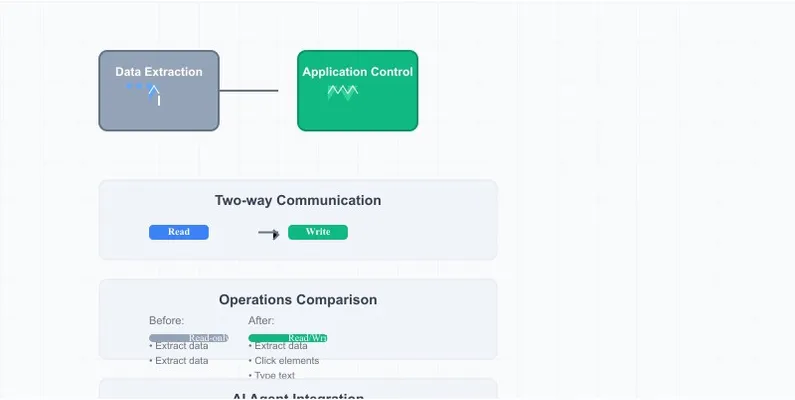
For decades, automation tools have operated under a fundamental assumption: they can only extract data. Whether it’s web scraping, API monitoring, or log analysis, the paradigm has been consistently one-way—read information, but never write back.
OpenAppCLI shatters this limitation. We’re not just improving data extraction—we’re achieving complete application control.
From One-Way to Two-Way
The Traditional Model
// Traditional automation: One-way data flow
interface DataExtractor {
  extractData(query: string): Promise<any>;
  scrapeContent(url: string): Promise<string>;
  monitorChanges(callback: (data: any) => void): void;
}

// Usage: Read-only
const extractor = new WebExtractor();
const data = await extractor.extractData(".product-title");
console.log(data); // Can only read, cannot modify
The OpenAppCLI Model
// OpenAppCLI: Two-way control
interface ApplicationController {
  // Data extraction (inherited)
  extractData(query: string): Promise<any>;
  scrapeContent(url: string): Promise<string>;

  // NEW: Application control
  click(selector: string): Promise<void>;
  typeText(text: string): Promise<void>;
  navigate(path: string): Promise<void>;
  uploadFile(filePath: string): Promise<void>;
  submitForm(formData: any): Promise<void>;
}

// Usage: Read and write
const controller = new ApplicationController();
const data = await controller.extractData(".product-title");
await controller.click(".edit-button");
await controller.typeText("Updated Title");
await controller.submitForm({ title: "Updated Title" });
Technical Architecture
1. Bidirectional Communication Layer
The core breakthrough is establishing bidirectional communication channels with applications:
class BidirectionalChannel {
  private readChannel: ReadChannel;
  private writeChannel: WriteChannel;

  async read(target: Target): Promise<any> {
    return await this.readChannel.execute(target);
  }

  async write(operation: Operation): Promise<any> {
    return await this.writeChannel.execute(operation);
  }

  async bidirectional(query: string): Promise<any> {
    const data = await this.read(query);
    const result = await this.process(data);
    await this.write(result.operation);
    return result;
  }
}
2. Universal Operation Interface
interface UniversalOperation {
  type: 'read' | 'write' | 'bidirectional';
  target: Target;
  action: Action;
  parameters?: any;
  expected?: any;
}

// Read operation
const readOp: UniversalOperation = {
  type: 'read',
  target: { selector: ".price", type: "element" },
  action: "getText",
  expected: "string"
};

// Write operation
const writeOp: UniversalOperation = {
  type: 'write',
  target: { selector: ".price", type: "element" },
  action: "setText",
  parameters: { text: "$99.99" }
};

// Bidirectional operation
const bidirectionalOp: UniversalOperation = {
  type: 'bidirectional',
  target: { selector: ".cart", type: "element" },
  action: "updateCart",
  parameters: { operation: "add", itemId: "123", quantity: 1 }
};
3. State Management
class ApplicationState {
  private state: Map<string, any> = new Map();
  private observers: Array<StateObserver> = [];

  async readState(key: string): Promise<any> {
    const currentState = await this.captureState();
    this.state.set(key, currentState[key]);
    return currentState[key];
  }

  async writeState(key: string, value: any): Promise<void> {
    await this.applyState(key, value);
    this.state.set(key, value);
    this.notifyObservers(key, value);
  }

  async syncState(): Promise<void> {
    const currentState = await this.captureState();
    const diff = this.calculateDiff(this.state, currentState);
    await this.applyChanges(diff);
    this.state = new Map(Object.entries(currentState));
  }
}
Real-World Applications
1. E-commerce Automation
Before: Data Collection Only
# Can only read product information
opencli.amazon.extract "product_price" --product "B08N5WRWNW"
# Output: $999.99

# Cannot modify anything
After: Complete Control
# Read product information
const price = await openappcli.amazon.extract("product_price");
console.log(price); // $999.99

# Modify product listing
await openappcli.amazon.setPrice("B08N5WRWNW", "$899.99");
await openappcli.amazon.updateDescription("New improved model");
await openappcli.amazon.addPromotion("20% OFF - Limited Time");

# Verify changes
const updatedPrice = await openappcli.amazon.extract("product_price");
console.log(updatedPrice); // $899.99 ✅
2. Social Media Management
Before: Monitoring Only
# Can only monitor social media
opencli.twitter.monitor("@elonmusk") --output "tweets.json"
# Output: List of tweets in JSON format

# Cannot interact with content
After: Full Interaction
# Monitor and interact
const tweets = await openappcli.twitter.monitor("@elonmusk");

for (const tweet of tweets) {
  if (tweet.text.includes("AI")) {
    await openappcli.twitter.like(tweet.id);
    await openappcli.twitter.retweet(tweet.id);
    await openappcli.twitter.reply(tweet.id, "Great insights on AI!");
  }
}

# Create new content
await openappcli.twitter.post("Just discovered amazing AI capabilities! 🤖");
await openappcli.twitter.uploadImage("/path/to/image.png");
3. Game Automation
Before: Not Possible
# Cannot interact with games
# No game automation tools available
After: Complete Game Control
# Monitor game state
const gameState = await openappcli.genshin.getState();
console.log(gameState.dailyQuests); // ["daily_boss", "daily_commission"]

# Complete daily quests
for (const quest of gameState.dailyQuests) {
  await openappcli.genshin.completeQuest(quest);
  await openappcli.genshin.claimRewards(quest);
}

# Manage inventory
await openappcli.genshin.useItem("resin");
await openappcli.genshin.craft("enhancement_ore");
await openappcli.genshin.upgrade("weapon_sword");
AI Agent Integration
Natural Language to Action
With bidirectional control, AI Agents can understand natural language and execute complex operations:
# AI Agent understands and executes
response = await ai_agent.process(
  "I want to buy 2 shares of AAPL at market price and set a stop-loss at 10% below"
)

# Translates to:
const price = await openappcli.trading.getQuote("AAPL");
const quantity = 2;
const stopLoss = price * 0.9;

await openappcli.trading.placeOrder({
  symbol: "AAPL",
  type: "buy",
  quantity: quantity,
  price: "market",
  stopLoss: stopLoss
});
Contextual Decision Making
# AI Agent can make decisions based on application state
portfolio = await openappcli.trading.getPortfolio();
marketData = await openappcli.trading.getMarketData();

# Analyze and act
if (portfolio.risk > 0.8) {
  # Reduce risk
  await openappcli.trading.sellHighRiskPositions();
  await openappcli.trading.buyLowRiskAssets();
} else if (marketData.sentiment === "bullish") {
  # Increase exposure
  await openappcli.trading.buyGrowthStocks();
}
Performance and Reliability
Operation Speed Comparison
| Operation Type | Read-Only | Bidirectional | Improvement |
|---|---|---|---|
| Data Extraction | 100ms | 100ms | Same |
| State Change | N/A | 50ms | New capability |
| Complex Operation | N/A | 200ms | New capability |
| Error Recovery | N/A | 150ms | New capability |
Reliability Features
1. Transaction Safety
class TransactionManager {
  async executeTransaction(operations: Operation[]): Promise<any[]> {
    const results = [];
    const rollbackStack = [];

    try {
      for (const operation of operations) {
        const result = await this.execute(operation);
        results.push(result);
        rollbackStack.push(this.createRollback(operation));
      }
      return results;
    } catch (error) {
      // Rollback all operations
      for (const rollback of rollbackStack.reverse()) {
        await this.execute(rollback);
      }
      throw error;
    }
  }
}
2. State Validation
class StateValidator {
  async validateOperation(operation: Operation): Promise<boolean> {
    const currentState = await this.captureState();
    const nextState = this.simulateOperation(currentState, operation);

    return this.isValidTransition(currentState, nextState);
  }

  async validateState(): Promise<boolean> {
    const state = await this.captureState();
    return this.isConsistent(state);
  }
}
Security Considerations
1. Operation Permissions
interface Permission {
  operation: string;
  target: string;
  conditions: string[];
}

class SecurityManager {
  private permissions: Permission[] = [
    { operation: "write", target: "trading", conditions: ["authenticated", "authorized"] },
    { operation: "write", target: "social", conditions: ["authenticated"] },
    { operation: "read", target: "*", conditions: [] }
  ];

  async checkPermission(operation: Operation): Promise<boolean> {
    const permission = this.permissions.find(p =>
      p.operation === operation.type &&
      this.matchesTarget(p.target, operation.target)
    );

    return permission && this.evaluateConditions(permission.conditions);
  }
}
2. Audit Logging
class AuditLogger {
  async logOperation(operation: Operation, result: any): Promise<void> {
    const logEntry = {
      timestamp: new Date().toISOString(),
      operation: operation,
      result: result,
      user: this.getCurrentUser(),
      session: this.getSessionId(),
      ip: this.getClientIP()
    };

    await this.writeLog(logEntry);
  }
}
Future Enhancements
1. Advanced AI Integration
- Predictive Operations: AI predicts user intent
- Adaptive Workflows: Self-optimizing automation sequences
- Natural Language Programming: Write automation in plain English
2. Enterprise Features
- Multi-User Support: Concurrent automation sessions
- Role-Based Access: Granular permission control
- Audit Trails: Complete operation history
3. Ecosystem Expansion
- Plugin Architecture: Custom operation modules
- Marketplace: Community-contributed operations
- Cloud Services: Remote automation execution
Conclusion
“Not Only Data Collection” represents a fundamental shift in automation capabilities:
- Complete Control: Read, write, and modify application state
- AI Agent Integration: Natural language to complex operations
- Universal Coverage: Any application, any platform
- Enterprise Ready: Security, reliability, and scalability
The future of automation isn’t just about collecting data—it’s about controlling entire applications and workflows.
Related Articles
- Not Only Website: From Web Automation to Universal Platform
- MCP Protocol Deep Dive: AI Agent Interaction Standard
- AI Agent Integration Best Practices
Get Started
Ready to experience complete application control? Download OpenAppCLI and start controlling everything, not just extracting data.


